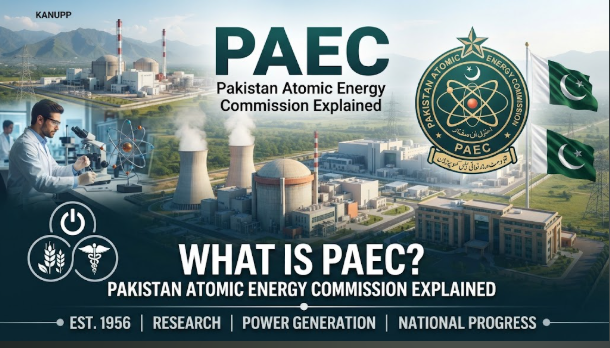
Pakistan Atomic Energy Commission (PAEC) is a federal government organization. It develops and runs Pakistan’s peaceful nuclear science and technology programs. The government formed it in 1956 to promote peaceful uses of nuclear science and technology in Pakistan. Today it is best known for running the country’s nuclear power plants, its cancer hospitals, and research centres in agriculture and industry.
Below is a plain explanation of what PAEC is and what it does.
When and why was PAEC established?
Prime Minister Huseyn Shaheed Suhrawardy set up PAEC in March 1956, after the government had formed a committee of scientists in 1955 to plan for nuclear energy. The main purpose was to use atomic technology for the country’s development, especially in electricity, health and agriculture.
In its early years, PAEC focused on training Pakistani physicists and engineers and building basic research facilities. The initial focus was to lay the foundation for a future nuclear program by training scientists and engineers. Stanford University
Some early milestones:
- In 1959, an agreement was signed to build a swimming-pool type research reactor.
- A nuclear medical centre was set up in Karachi in 1961.
- A nuclear research centre was set up in Lahore in 1963, and the same year the first nuclear agriculture centre opened at Tandojam.
- Dr. Ishrat Hussain Usmani chaired PAEC from 1960 to 1971.
What does PAEC do?
Pakistan Atomic Energy Commission’s work falls into a few main areas. The details below come from official and reliable public sources, but PAEC’s own website is the best place to check its latest activities.
1. Nuclear power generation
This is PAEC’s best-known job. PAEC is responsible for all nuclear energy and research applications in the country. Its reactors add electricity to the national grid. World Nuclear Association
Pakistan currently operates six nuclear power plants with a combined installed capacity of 3,530 MW(e). These are located at two sites: The Nation
- Karachi (KANUPP): PAEC’s first power reactor, K-1, was a small Canadian-supplied heavy water reactor at Paradise Point, about 25 km west of Karachi. Newer, larger units (K-2 and K-3) have since been added at the Karachi site. World Nuclear Association
- Chashma (Mianwali, Punjab): The site hosts four operating Chinese-supplied CNP-300 reactors. Chashma units C-1 to C-4 entered commercial operation in 2000, 2011, 2016 and 2017.
A reported figure from early 2025 said nuclear energy contributes about 27% of total electricity generation in the national grid. This share can change from year to year, so treat it as approximate. Nuclear Engineering International
2. Chashma Unit 5 (C-5): the upcoming plant
C-5 is PAEC’s biggest current project. It will be Pakistan’s largest nuclear plant, with a capacity of 1,200 MWe. Pakistan’s nuclear regulator issued the construction license on December 26, 2024, and the reactor is a Chinese Hualong design with a 60-year design life. The IAEA Board of Governors approved the safeguards agreement for C-5 in March 2026. The unit is expected to start operating around 2030. Pakistan begins construction of Chashma 5 – Nuclear Engineering International.
3. Nuclear medicine and cancer treatment
Many people know PAEC through its hospitals, not its power plants. PAEC has set up centres across the country that use nuclear techniques to diagnose and treat cancer and related diseases, these include:
- Atomic Energy Medical Centre (AEMC)
- Karachi Institute of Radiotherapy and Nuclear Medicine (KIRAN)
- Multan Institute of Nuclear Medicine and Radiotherapy (MINAR)
- Institute of Nuclear Medicine and Oncology (INMOL), Lahore
- Punjab Institute of Nuclear Medicine (PINUM), Faisalabad
- Centre for Nuclear Medicine (CENUM), Centre for Nuclear Medicine and Radiotherapy (CENAR) and others
Treatment fees, eligibility for free treatment and waiting times differ by centre. Check with the specific hospital.
4. Agriculture, food and industry
PAEC runs nuclear agriculture research, which includes developing improved crop varieties and studying soil, water and food preservation. The Tandojam centre mentioned earlier is one of the first of these. PAEC also supports research in industrial applications and materials science.
5. Education and training
PAEC founded the Pakistan Institute of Engineering and Applied Sciences (PIEAS) in Islamabad. PIEAS is ranked among the country’s primary technical institutes, and many PAEC engineers and scientists have served there. PAEC also trains its own staff in nuclear science, engineering and radiation safety.
Does PAEC control nuclear weapons?
This question comes up often, so here is a short and accurate answer.
The PAEC was originally focused only on peaceful uses of nuclear energy. In 1972 it was tasked to produce a nuclear weapon, and the 1998 tests were conducted under PAEC. However, the structure changed later. The National Command Authority (NCA) was created and took over responsibility for nuclear weapons from PAEC. The NCA was established in February 2000 to make all major decisions on nuclear policy, procurement, planning and use.
Today PAEC’s public role is mainly civilian: power, medicine, agriculture and research.
Who regulates PAEC?
PAEC builds and operates nuclear facilities, but it does not regulate itself. The Pakistan Nuclear Regulatory Authority (PNRA) does that. PNRA was formed in 2001, replacing the earlier regulatory board that PAEC had set up. PNRA issues licenses, as it did for C-5, and inspects safety and security. World Nuclear Association
Pakistan’s civilian power reactors also work under international oversight. The civil power reactors and two research reactors are under item-specific IAEA safeguards. World Nuclear Association
Who leads PAEC and where is it based?
PAEC’s headquarters is in Islamabad. As of September 2026, its chairman is Dr Raja Ali Raza Anwar. Leadership can change, so confirm on the official website if you need this for an exam or interview. The Nation
How do jobs at PAEC work?
Many readers of a site like ours are searching for PAEC jobs, so here is what is generally true. Always treat the official advertisement as the final authority on eligibility, age limits, salary and deadlines.
General information (not fixed rules):
- PAEC hires for a wide range of posts, including scientists, engineers, medical staff, technicians and administrative staff. Qualification levels in recent advertisements have ranged from middle and matric up to master’s and doctoral degrees.
- Applicants are generally required to apply online through the careers section of paec.gov.pk, but some advertisements ask for applications by post or courier to a specific address. Jobsalert
- Recent advertisements have often used separate online portals, or PO Box addresses, for different PAEC units. These links change with each ad, so use only the link printed in the official advertisement.
- Applicants already in government or semi-government jobs generally need a No Objection Certificate (NOC) at the test or interview stage. Join Pak Army Jobs
- Selection typically involves a written test and interview, but the exact steps depend on the post.
Official requirements: Age limits, educational requirements, experience, domicile or quota rules, salary scale and last date can differ for each post and each advertisement. We are not listing them here because they change, and inventing them would be misleading. Read the full advertisement each time.
Stay careful: Many unofficial websites copy PAEC job news, and some are not accurate. Never pay money to anyone who promises you a PAEC job. PAEC does not sell jobs through agents.
Frequently asked questions
Is PAEC a government organization?
Yes. It is a federal government body based in Islamabad.
Is PAEC part of the army?
No. PAEC is a civilian scientific organization. It works with other national institutions, but it is not a military force.
What is the difference between PAEC and PNRA?
PAEC develops and runs nuclear programs and plants. PNRA is the independent regulator that licenses and inspects them for safety.
Where are Pakistan’s nuclear power plants?
At two sites: Karachi (Sindh) and Chashma near Mianwali (Punjab).
Can anyone get treatment at PAEC hospitals?
PAEC Centres treat patients from across the country, mainly for cancer and related conditions. Fees and free-treatment rules differ by Centre, so contact the specific hospital.
Where can I find real PAEC job ads?
Check the careers section of PAEC’s official website, paec.gov.pk, and the official newspaper advertisement.
Conclusion
PAEC is Pakistan’s main civilian nuclear organization. It has been working since 1956 to supply electricity, treat cancer patients, improve agriculture and train scientists. With six operating nuclear plants and a large new unit under construction at Chashma, it will remain an important part of the country’s energy plans. If you want to work there, rely only on official advertisements and never on unverified websites.