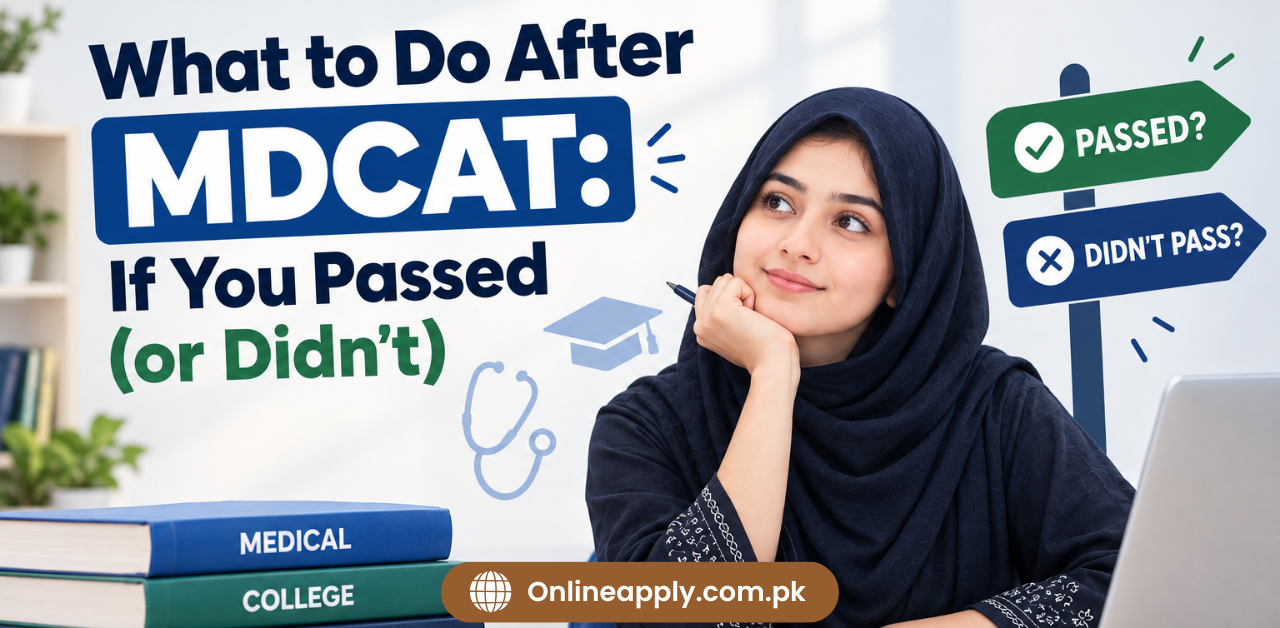
The MDCAT result is out, your phone is blowing up, and every relative suddenly has an opinion. Maybe you passed and you’re already picturing the white coat. Maybe you didn’t and your brain is in full “sab khatam” mode.
Take a breath. Whichever side you’re on, you have options, and this guide covers both scenarios: what to do if you passed, what to do if you didn’t, and how to pick a path without regretting it later.
One thing first: one exam result does not decide your whole life. It feels like it does right now, but it doesn’t.
Quick Summary (For the Skimmers)
| Your situation | What to do |
|---|---|
| Passed MDCAT | Calculate your aggregate, check last year’s closing merit, prepare documents, apply on time, make a smart preference list |
| Passed but merit is low | Look at private colleges, self-finance seats, and keep a backup plan running |
| Didn’t pass | Decide between a retake, other health fields (DPT, Pharm-D, etc.), non-medical fields (CS, IT, finance), or studying abroad |
First, Understand What Your Result Actually Means
A lot of students mix up two totally different things:
- Passing MDCAT means you crossed the minimum required marks.
- Getting a seat means your aggregate was high enough to make it into a merit list for a specific college.
These are not the same thing. You can pass MDCAT and still not get into a public medical college. This is the biggest misunderstanding around the exam, and it hurts a lot of students who relax after seeing “Passed” on their result.
Your final merit is usually calculated as an aggregate of three things:
- Your MDCAT score
- Your FSc (or equivalent) marks
- Your Matric marks
MDCAT usually carries the heaviest weightage, but the exact percentages can change, so check the official PMDC and provincial admission notifications for this year’s formula. Don’t trust a random WhatsApp forward or a cousin’s memory.
Quick self-check:
- Did you cross the passing marks? → Go to Scenario 1.
- Did you fall short of passing marks? → Go to Scenario 2.
- Did you pass but your aggregate looks too low for public colleges? → Read both. Scenario 1 for the process, Scenario 2 for backups.
Scenario 1: You Passed MDCAT
Congrats, seriously. That’s a real achievement. But the game isn’t over yet, so let’s not celebrate too hard just yet.
Passing ≠ Guaranteed Seat (Read This Twice)
Here’s the reality check nobody gives you at the result party:
- Merit lists are super competitive. Thousands of students pass, but seats are limited, especially in public colleges.
- Closing merit changes every year. Last year’s cutoff is a guide, not a promise. It moves depending on paper difficulty, number of applicants, and seat availability.
- Every college has its own cutoff. A top college in Lahore or Karachi will close much higher than a college in a smaller city.
- Open merit vs. reserved seats matter. There are seats reserved for specific districts, provinces, and categories, and where you’re from affects your chances.
- Province matters too. Your domicile decides which quotas and seats you can apply for.
So the plan is simple: celebrate for a day, then get to work. Students who move fast on paperwork and planning are the ones who don’t panic later.
Your Step-by-Step Action Plan
Step 1: Calculate Your Aggregate
Use the official formula and your actual marks (MDCAT, FSc, Matric). Do the math yourself and double-check it. Don’t rely on a random “aggregate calculator” website without verifying the formula it uses.
Step 2: Check Previous Years’ Closing Merit
Look up closing merits of the last 2 to 3 years for the colleges you’re interested in. This tells you three things:
- Which colleges are realistic for you
- Which ones are a stretch
- Which ones are safe
Remember, it’s a guide, not a guarantee.
Step 3: Get Your Documents Ready Early
Don’t wait until the deadline is 2 days away. Usually you’ll need things like:
- Domicile certificate
- Matric and FSc result cards and certificates
- CNIC / B-form (yours and your parent’s)
- Passport-size photos
- MDCAT result
- Any category-specific documents (like reserved seat proof)
Get attestation, copies, and scans sorted in advance. Trust me, the last-minute document rush is a whole different level of stress, and government offices don’t care about your deadline.
Step 4: Apply on Time on the Right Portals
Each province and each university may have its own application process. Follow the official portals and notifications, keep screenshots of your submissions, and never miss the deadline. A missed deadline is a lost year, and no one will feel bad for you.
Step 5: Build a Smart Preference List
Don’t just fill in your dream college and leave the rest random. Structure it like this:
- Dream colleges: the ones you’d love but where the cutoff is a stretch
- Realistic colleges: where your aggregate is around or slightly above the usual closing merit
- Safe colleges: where you’re comfortably above the usual cutoff
Order matters. Put your preferences in the order you actually want them, because the system allots based on your list.
Step 6: Watch the Merit Lists and Objection Windows
Once the merit lists come out, check your name and marks carefully. If something looks wrong, there’s usually a limited window to raise an objection. Miss that window and you can’t do much about it later.
What If You Miss the Public Merit List?
Not getting into a public college hurts, but it’s not the end of the road. You still have options.
Private Medical Colleges
Private colleges have their own admission processes and fee structures, which are usually much higher than public ones. Before you even think about applying:
- Verify that the college is recognized by PMDC. This is non-negotiable. A degree from an unrecognized college can mean you can’t get registered or practice.
- Check the total fee, not just the first-year fee. Ask about the full 5-year cost, hostel, and other charges.
- Talk to current students and alumni, not just the admission office.
Self-Finance Seats
Some public colleges also offer self-finance seats with a higher fee than regular seats but usually lower than fully private ones. Keep an eye on these announcements.
Beware of Scams
Every year, fake “guaranteed admission” consultants and unrecognized colleges trap students. If someone promises you a seat without merit, in exchange for money, run. Real admissions happen through official channels.
Keep a Backup Plan Running
While waiting for lists, don’t sit idle. Look at the alternatives in Scenario 2, because those options aren’t just for students who failed. They’re also for students who passed but didn’t make the cut for a college they can afford.
Scenario 2: You Didn’t Pass or Didn’t Get a Seat
First of all, come here. It’s okay.
Deal With the Emotional Side First
Feeling crushed is normal. You put in months (maybe years) of effort, gave up sleep, gave up Netflix, gave up your social life, and the result didn’t match. That hurts.
I’ve been where you are. Once upon a time, I also dreamt of becoming a doctor. I had the whole picture in my head, white coat and everything. It didn’t work out. But look at me now: I’m an IT expert, working on stuff I genuinely love, earning well, all from my home with no limits. No hospital duties, no 36-hour shifts, just skills, laptop and wifi. I’m not saying this to flex. I’m saying it because that “failure” pushed me toward the thing I was actually meant to do. Your story can go the same way.
Here are a few things that actually help:
- Give yourself a few days. Be sad, be annoyed, sleep, go outside, whatever you need.
- Don’t make big decisions on day one. A clear head makes better choices than a panicked one.
- Ignore the pressure from relatives and “Shakeel bhai ka beta/beti” comparisons. Their opinions aren’t paying your fees or living your life.
- Talk to someone. A friend, sibling, teacher, or counselor. Don’t bottle it up.
Once you’ve calmed down, you can look at your options properly. There are four main paths.
Path A: Retake MDCAT
Who Should Consider It
A retake makes sense if:
- You were close to the passing marks or the merit cutoff
- You know exactly where you went wrong (specific subjects, time management, silly mistakes)
- You still genuinely want to be a doctor, not because of family pressure, but because you want it
- You can afford the extra year financially and mentally
Who Should Think Twice
Be honest with yourself if:
- You’ve already attempted more than once with no real improvement
- You’re only retaking because you don’t know what else to do
- Your marks were far below the passing mark, and your prep strategy hasn’t changed
How to Do It Smarter This Time
- Analyze your weak sections. Which subject dragged you down? Biology, Chemistry, Physics, English, Logical Reasoning?
- Change your strategy. Doing the same thing again and expecting different results doesn’t work.
- Practice past papers and full-length mocks under exam conditions.
- Fix your time management. A lot of students know the material but run out of time.
- Keep a parallel backup. Consider enrolling in a degree (even part-time or a first-year program) so the year isn’t fully “wasted.” Check the rules first, because some admissions and retake policies have conditions.
Also, verify the current retake rules and attempt limits from official sources, since they can change.
Path B: Other Medical and Health Fields
Here’s something people don’t tell you: healthcare isn’t only MBBS. There are plenty of respected, in-demand health careers, and many of them have great scope in Pakistan and abroad.
DPT (Doctor of Physical Therapy)
- Duration: 5 years
- What it is: You treat patients through movement, exercise, and rehab (sports injuries, back pain, stroke recovery, and more).
- Scope: Hospitals, clinics, sports teams, private practice, and abroad.
- Why students like it: You get the “Dr.” title, patient interaction, and the option to open your own clinic.
Pharm-D (Doctor of Pharmacy)
- Duration: 5 years
- What it is: Medicines, drug interactions, clinical pharmacy, and pharmaceutical industry work.
- Scope: Hospital pharmacy, pharma companies, drug regulation, research, and retail.
- Good for: Students who liked Chemistry and Biology and want stable career options.
BS Nursing
- Duration: 4 years
- What it is: Patient care, clinical support, and healthcare management.
- Scope: Very high demand both locally and internationally. Nurses are in demand across the Gulf, UK, Canada, and more.
- Note: This field is seriously undervalued in Pakistan’s conversation, but the job market is strong.
BS Medical Laboratory Technology (MLT)
- Duration: 4 years
- What it is: Diagnostic testing, pathology, blood work, and lab management.
- Scope: Hospitals, diagnostic labs, research, and even starting your own lab later.
BS Psychology / Clinical Psychology
- Duration: 4 years
- What it is: Understanding behavior and mental health. Clinical routes involve therapy and counseling.
- Scope: Mental health awareness is finally growing in Pakistan. Counseling, HR, education, research, and clinical practice are all options. (Clinical practice usually needs further specialization, so plan for that.)
Optometry
- Duration: 4 years
- What it is: Eye care, vision testing, and eye health.
- Scope: Hospitals, eye clinics, optical businesses, and abroad.
Nutrition and Dietetics
- Duration: 4 years
- What it is: Diet planning, clinical nutrition, and lifestyle health.
- Scope: Hospitals, fitness industry, private practice, and content creation, especially with the wellness trend growing.
Public Health / Biotechnology
- Duration: 4 years
- What it is: Public health covers disease prevention, health policy, and community programs. Biotech covers research, genetics, and lab-based science.
- Scope: NGOs, research institutes, government programs, and international health organizations.
BDS (Bachelor of Dental Surgery)
- Duration: 5 years
- Note: This is usually for students who qualified through MDCAT but missed MBBS. The passing requirement is often slightly different, so check current rules. Dentistry has strong private practice scope.
Quick Comparison Table
| Field | Duration | Difficulty | Job Scope in Pakistan |
|---|---|---|---|
| DPT | 5 years | Medium-High | Very good |
| Pharm-D | 5 years | High | Good to Very good |
| BS Nursing | 4 years | Medium | Very high (local + abroad) |
| BS MLT | 4 years | Medium | Good |
| BS Psychology | 4 years | Medium | Growing |
| Optometry | 4 years | Medium | Good |
| Nutrition | 4 years | Medium | Growing |
| BDS | 5 years | High | Good |
(Difficulty and scope are general estimates and vary by institution and individual effort.)
Path C: Non-Medical Fields
Maybe this MDCAT result made you realize medicine isn’t really your thing. That’s completely valid. Some of the most successful people started somewhere they didn’t plan to.
Computer Science / Software Engineering
Tech is one of the biggest fields for Pakistani students right now. You can work in a company, freelance, or build your own product. Skills matter more than the degree label here.
IT, Data Science, and AI
If you like problem-solving and data, this is a hot area. AI, machine learning, and data analytics are growing fast, and remote jobs are a real possibility.
BBA, Finance, and Accounting
Business, banking, and finance are stable career paths. You can also go for professional certifications like ACCA or CFA, which are globally recognized and can be pursued alongside or after your degree.
Digital Skills (Freelancing Route)
This is the path a lot of people underestimate. Web development, SEO, content writing, graphic design, video editing, and social media management can all turn into real income, sometimes even before you finish your degree. Pakistan has a big freelancing scene, and clients pay in dollars.
Important Note for Pre-Medical Students
If you did FSc Pre-Medical and want to go into CS or engineering, many universities ask you to complete deficiency courses (usually Mathematics). Check eligibility with your target university before applying, so you don’t get a surprise later.
Path D: Study Abroad (Short Version)
Some students consider studying medicine or other fields abroad. It can work, but be careful:
- Check PMDC recognition for any foreign medical degree before you commit. If it’s not recognized, you may face problems getting registered in Pakistan.
- Beware of consultants with huge promises. If it sounds too easy, there’s usually a catch.
- Count the full cost, including tuition, living, travel, and currency changes.
How to Choose the Right Path
It’s easy to get overwhelmed. Ask yourself these four questions:
- Interest: What would I still enjoy doing when it gets hard?
- Budget: What can my family realistically afford without huge stress?
- Time: Am I okay with a 4-5 year program, or a year-long retake?
- Market demand: Does this field actually have jobs and growth?
Some extra tips:
- Talk to seniors and working professionals in the fields you’re considering. Two 15-minute chats will teach you more than hours of scrolling.
- Don’t pick something just because it’s a “backup.” If you treat it like a consolation prize, you’ll feel stuck. Pick something you can actually grow in.
- Don’t follow the crowd blindly. Just because everyone is picking CS or DPT doesn’t mean it fits you.
Students Often Ask:
Can I retake MDCAT?
Yes, in most cases students can reappear, but rules on attempts and eligibility can change. Always check the latest official notification.
Is passing MDCAT enough for admission?
No. Passing only makes you eligible. Your admission depends on your aggregate and the merit list of the college you apply to.
Which field is best after failing MDCAT?
There’s no single best option. DPT, Pharm-D, and Nursing are popular for health-focused students, while CS, IT, and finance suit those wanting a different direction. Choose based on your interest and budget.
Can pre-medical students do CS?
Yes, but many universities require you to complete deficiency courses like Mathematics. Check with the specific university.
Are private medical colleges worth it?
They can be, if the college is PMDC-recognized and the fee is manageable for your family. Do your research, talk to current students, and never pay based on promises alone.
Final Words
Let’s do a quick recap:
- If you passed: Don’t relax. Calculate your aggregate, prepare documents early, apply on time, and make a smart preference list. Keep private and self-finance options in mind.
- If you didn’t: Take time to process it, then choose between a smarter retake, other health fields, non-medical paths, or studying abroad (carefully).
MDCAT is one exam on one day. It doesn’t measure your worth, your intelligence, or your future. Plenty of successful people in medicine, tech, business, and everything in between took a completely different route than they planned.
Pick the path that fits you, work hard on it, and don’t let anyone else’s timeline pressure you. You’ve got this.
If this guide of mine helped you, share it with a friend who’s stressing about their result, and drop your questions in the comments. We’ll try to answer as many as we can.