MBBS merit was brutal this year, or maybe you just don’t see yourself in a white coat for 20 years, and now everyone at home is asking “so, what’s the plan?” But, you don’t need a Plan B that feels like a downgrade. Meet DPT, the Doctor of Physical Therapy.
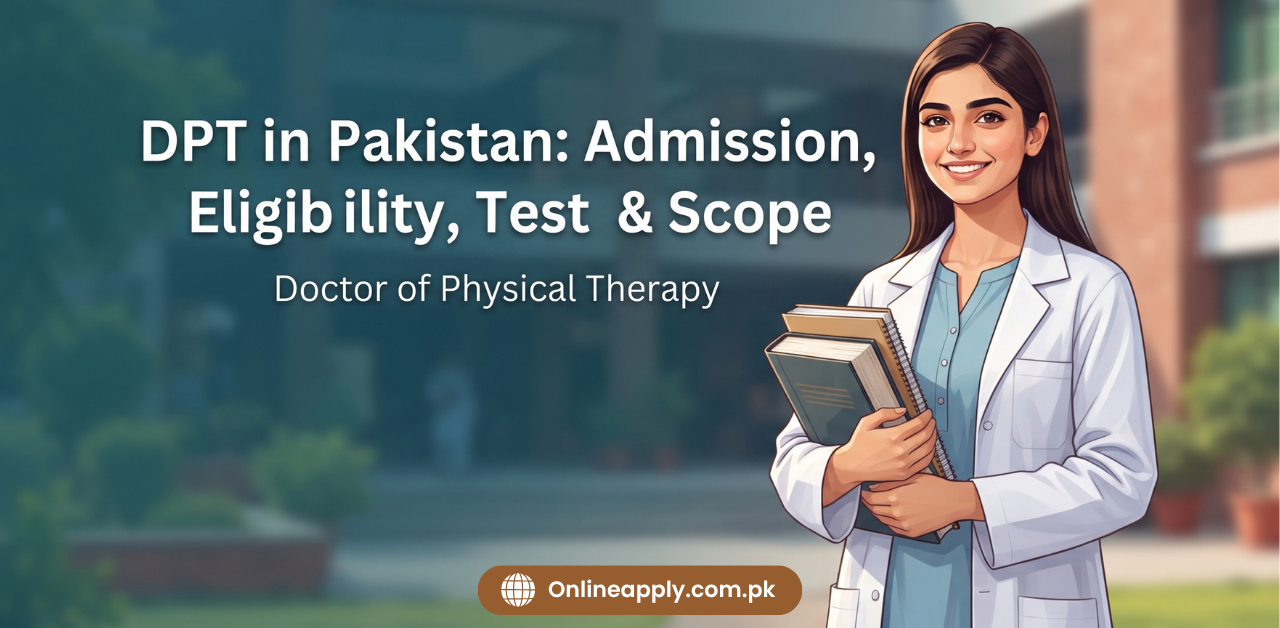
DPT is a professional degree, just like MBBS and BDS. Instead of prescribing medicines or doing surgery, you help people move, recover and live pain-free. It covers sports injuries, stroke rehab, back pain, cardiac recovery and post-surgery rehabilitation. The field is growing fast and the degree is respected, but getting in usually means clearing an aptitude test, and that’s where most students mess up.
This guide covers the whole journey: what DPT is, eligibility, admissions, and a deep dive into the aptitude test, including its pattern, sample papers and preparation strategy. Let’s go.
What Is DPT? (And What Do Physical Therapists Actually Do?)
Doctor of Physical Therapy (DPT) is a five-year undergraduate professional degree in physical therapy (physiotherapy). It runs for 10 semesters, is equivalent to 17 years of schooling, and is endorsed by the Higher Education Commission (HEC). Says riphahsahiwal
A physical therapist assesses movement problems caused by injury, illness or disability, and treats them through:
- Exercise therapy: targeted strengthening and mobility programs
- Manual therapy: hands-on techniques for joints and soft tissue
- Electrotherapy: ultrasound, TENS, interferential current and similar modalities
- Preventive care: posture correction, ergonomics and injury prevention
The major specialty areas are:
- Musculoskeletal: back pain, arthritis, fractures, sports injuries
- Neurological: stroke, spinal cord injury, cerebral palsy, Parkinson’s
- Cardiopulmonary: post-heart-attack and chronic lung disease rehabilitation
- Pediatrics: developmental delays and childhood disorders
- Sports physiotherapy: athletes, performance and return-to-play
DPT vs MBBS vs BDS, quick snapshot:
| DPT | MBBS | BDS | |
|---|---|---|---|
| Duration | 5 years | 5 years | 4 years |
| Focus | Rehabilitation and movement science | Diagnosis, medicine and surgery | Oral and dental health |
| Entry | Usually aptitude/entry test + FSc marks | MDCAT | MDCAT |
| Practice style | Clinic, hospital, sports, private practice | Hospital/clinic | Dental clinic |
DPT is not a lesser version of MBBS. It’s a different profession with its own clinical role, and many people find the work-life balance much healthier.
DPT Course Details
The DPT curriculum is standardized across the country under HEC guidance, so the broad structure is similar everywhere. The HEC-endorsed curriculum covers 5 years and 10 semesters with a minimum of 175 credit hours. Individual universities may differ slightly. For example, the University of Chenab’s DPT program details list 139 credit hours, so always check your university’s own prospectus.
Typical year-wise flow:
- Year 1: Anatomy, physiology, biochemistry, basic kinesiology, English and Islamiat/Pakistan Studies
- Year 2: Advanced anatomy, pathology, biomechanics, exercise physiology, electrotherapy basics
- Year 3: Musculoskeletal, neurological and cardiopulmonary physical therapy, pharmacology, research methods
- Year 4: Clinical specialties, sports therapy, pediatrics, community rehabilitation, evidence-based practice
- Year 5: Mostly clinical rotations and internship (often called the house job) in hospitals and rehab centers
The last year is where you stop being a student on paper and start working with real patients. Most programs also require a research project, so get comfortable with terms like sample, variables and SPSS. As you’ll see, even the entry test now asks about them.
DPT Eligibility Criteria
The basics are simple. Under the HEC-prescribed DPT criteria, candidates need at least 60% marks in HSSC with a pre-medical, health sciences, applied sciences or basic medical sciences group or equivalent. I.Com and Arts students are not eligible.
Checklist:
- FSc Pre-Medical (or equivalent such as A-Levels with Biology, Chemistry and Physics/Maths) with at least 60%
- Foreign qualifications need an IBCC equivalence certificate
- Passing the university’s entry/aptitude test (and sometimes an interview)
- Age and domicile rules, which vary by university and province
Since seat availability and minimum marks can differ between public and private universities, always read the admission notice before applying.
DPT Admission Process in Pakistan: Step by Step
The exact process varies by university, but the pattern is basically the same everywhere:
Step 1: Watch for admission announcements. Universities post ads on their websites and social media, usually after FSc results. Private universities often run two intakes (spring and fall).
Step 2: Apply online. Fill the form, upload your documents and pay the application fee.
Step 3: Appear in the aptitude/entry test. This is the main filter, and we’ll break it down in the next section.
Step 4: Merit calculation. Universities combine your academic record with your test score. One example is a 70% FSc and 30% test formula. Others add weightage for matric, an interview, or use a different ratio. The formula is always in the prospectus.
Step 5: Merit list and fee submission. Selected candidates have a short window to submit their dues and confirm the seat. Miss it, and the seat goes to the next person on the list.
Step 6: Document verification and orientation. Keep originals of your matric and FSc certificates, CNIC/B-Form, domicile and photographs ready.
Some universities accept scores from a centrally held test, such as a provincial health sciences university test, instead of or alongside their own. If you already have a recent score, check whether it can be used.
When Do DPT Admissions Start in Pakistan? (Timeline & Dates)
There is no single national DPT calendar. Every university announces its own dates, but most of the action happens between November and February, with merit lists running into March.
| Stage | Usual timing |
|---|---|
| Admission notices published | November to January |
| Application deadlines | December to February (some run later) |
| Aptitude test / interview | Usually a few weeks after the deadline |
| Merit lists | February to March, often in several rounds |
Here is how last cycle’s notices looked:
- Dow University of Health Sciences: announced 13 Nov 2025, deadline 13 Dec 2025
- Liaquat University of Medical and Health Sciences (Jamshoro): posted 8 Dec 2025, closed 19 Dec 2025
- CMH Lahore Medical College (School of Allied Health Sciences): applications 5 to 31 Dec 2025, aptitude test reported for 10 Feb 2026, merit lists running into March 2026
- Foundation University Islamabad: 7 Dec 2025 to 14 Jan 2026
- Aziz Fatimah Medical & Dental College (Faisalabad): 24 to 29 Dec 2025
- Sir Syed CASE Institute of Technology: deadline 4 Feb 2026
- Altamash College of Physical Therapy: applications until 5 April 2026
For the current cycle, Liaquat National Hospital’s DPT 2027-2031 admissions are reported to close on 30 November 2026. Confirm that on the hospital’s official site.
Quick tips:
- Keep your documents scanned and ready, since some windows are only about a week.
- Apply to more than one university, because deadlines and test dates rarely line up.
- Treat the university’s own website as the final word, and start test prep before the notice appears.
These are last cycle’s dates, so use them as a pattern, not a promise.
The DPT Aptitude Test: Pattern, Syllabus and What to Expect
This is the section that actually decides whether you get in, so read it carefully.
What Is the DPT Aptitude Test?
There is no single national DPT entrance exam like MDCAT. Each university (or sometimes a group of universities) designs its own aptitude or entry test. That means the pattern, question count and timing differ from place to place. The good news is that the syllabus is basically FSc level with a little extra.
The five usual subjects are:
- Biology (with human anatomy and physiology flavor)
- Chemistry
- Physics
- English
- General Knowledge (IQ)
Test Pattern Comparison
Here’s how the patterns look in the sample papers and official instructions you can access right now:
| Source | Format | Questions | Time | Sections |
|---|---|---|---|---|
| CMH official test guidelines | Online, home-based | 40 MCQs | 35 minutes | Not specified in the instructions |
| University of Chenab sample paper | Sample MCQ paper | 100 MCQs | Not stated | Mixed: science, English, GK, DPT-specific topics |
| SBBD University sample paper | Sample MCQ paper | 20 sample MCQs (5 per section) | Not stated | English, Chemistry, Biology, Physics |
| Imtehan mock test | Full-length practice mock | 115 MCQs | 90 minutes | Biology & Human Anatomy, Chemistry, Physics, English |
Important: the sample papers are samples. They show you what kind of questions to expect, not the guaranteed format of this year’s paper. Always confirm the real pattern in your university’s admission notice. Still, together they give a very clear picture.
Test-Day Rules for Online Tests
Some universities now conduct the aptitude test online. The official guidelines for one such test (session 2023-24) show what that looks like in practice:
- Login credentials are emailed one day before the test
- The test was 40 questions in 35 minutes, which works out to under a minute per question
- A laptop or desktop is recommended over a phone or tablet
- Use Chrome, Firefox or Opera, clear your cache and remove extra extensions
- Internet speed should be above 4 Mbps and the device should have more than 4 GB RAM
- Don’t open other tabs or applications during the test
- Log in at least 15 minutes early
- Logging in from a second place terminates your first session
- You can change your answers until time ends
- If your internet or power drops, you can log back in only within the allotted test time
- Keep a backup internet connection, stable electricity and a quiet room with nobody around
Even if your test is on-campus, the lesson applies: be early, be calm, and know the rules before the day.
What the Sample Papers Tell Us
1. The University of Chenab sample (100 MCQs) is the most informative. The paper roughly moves through three zones:
- Basic science: scalar vs vector, Ohm’s law, pH, atomic number, photosynthesis, blood groups
- English and general knowledge: passive voice, synonyms and antonyms, spelling, prepositions, plus GK like world geography and Pakistan-related questions
- DPT-flavored questions: this is where it gets interesting. There are questions on the Babinski sign, the Golgi tendon organ, the ECG P-wave, steppage gait in foot drop, VO2 max, energy systems in sprinting, muscle fiber types, and even research methodology (sample, dependent variable, PICO, SPSS)
So the bar is higher than plain FSc for some tests. Reading a little beyond the textbook helps.
2. The SBBD University sample is more basic. The paper is split into four labeled sections, English, Chemistry, Biology and Physics, with topics like synonyms, tenses, covalent bonds, electronegativity, circulatory system, kinetic energy and electric current. It’s a good confidence-builder for day one of preparation.
3. The Imtehan mock gives a structure you can actually practice with. Imtehan’s DPT prep system lists four subjects, a 115-question, 90-minute full mock, a 50% passing mark, and no negative marking in their mocks. Their key-facts section also notes that Biology carries the most marks, so it’s your biggest lever. Remember, this is their practice pattern, so treat it as training, not as the official rule of every university.
Subject-Wise Breakdown (What to Focus On)
Across these sources, the content clusters into these areas:
| Subject | What shows up | Priority |
|---|---|---|
| Biology | Human anatomy and physiology, blood, circulatory and nervous system, genetics, cell cycle, nutrition and vitamins, diseases | Highest |
| Chemistry | Periodic table, chemical bonding, acids/bases, pH, organic chemistry basics, equilibrium | High |
| Physics | Units and measurements, vectors vs scalars, motion and energy, waves, electricity, modern physics | Medium |
| English | Grammar, tenses, voice, vocabulary, spelling, antonyms, sentence completion | Medium (easy marks) |
| Logic/IQ/GK | Number sequences, basic reasoning, current affairs and general knowledge | Low to medium |
| DPT-specific | Basic neuro signs, muscle physiology, exercise science, research basics | Bonus (extra edge) |
English is the most underrated subject. It’s the easiest to score in, and students who ignore it lose marks they didn’t need to lose.
Past Paper Insight: What Repeats?
A past paper from 2013 gives a peek into how a physiotherapy-related entry test was built years ago. It’s a recollection-based list, so it’s incomplete and old. Use it to spot topic trends, not as a prediction of this year’s paper.
What stands out:
- Genetics is a repeat offender. Down’s syndrome chromosome count and Klinefelter’s syndrome appear more than once, along with cell cycle topics
- Diseases and health basics, such as cholera (cause and transmission) and CPR
- Numerical physics, like percentage error, radioactive half-life, momentum conservation and the equation of continuity
- Organic chemistry questions on aldehydes and acidity, plus Le Chatelier-type equilibrium
- Verbal and logic items, including a number-sequence question and vocabulary like “satire” and “counsel” vs “consul”
So even back then, the test mixed concept recall with calculation-based thinking. Expect the same today.
Sample Questions to Test Yourself
Here are some original practice MCQs in the same spirit (not copied from any paper). Answers are at the end.
Biology
- Which part of the brain is mainly responsible for coordination of voluntary movements?
A) Cerebrum B) Cerebellum C) Thalamus D) Medulla - Which cells are responsible for producing antibodies?
A) Neutrophils B) Platelets C) B-lymphocytes D) Erythrocytes
Chemistry
3. Which type of bond is formed by the transfer of electrons?
A) Covalent B) Ionic C) Hydrogen D) Metallic
4. The pH of a strongly acidic solution would be closest to:
A) 1 B) 7 C) 10 D) 14
Physics
5. The SI unit of power is:
A) Joule B) Newton C) Watt D) Pascal
6. Which of the following is a vector quantity?
A) Mass B) Speed C) Energy D) Displacement
English
7. Choose the correct sentence:
A) She have finished her work. B) She has finished her work. C) She finishing her work. D) She finish her work.
8. The antonym of “scarce” is:
A) Rare B) Plentiful C) Limited D) Tiny
Answers: 1-B, 2-C, 3-B, 4-A, 5-C, 6-D, 7-B, 8-B
How to Prepare for the DPT Aptitude Test
Build a Smart Study Plan
If you have 3 months:
- Month 1: Revise FSc Biology and Chemistry concepts from your textbooks. Focus on understanding, not just cramming
- Month 2: Physics and English, plus topic-wise MCQ practice
- Month 3: Full-length mocks, weak-area revision, and timed practice
If you have 1 month:
- Week 1: Biology (highest weightage)
- Week 2: Chemistry and Physics key topics
- Week 3: English and logic, plus daily MCQ sets
- Week 4: Full mocks only, then analyze your mistakes
Subject Strategy
- Biology: Go deep into human physiology, genetics, nutrition, diseases and the nervous and circulatory systems. Add basic physiotherapy terms like reflexes, gait types and muscle physiology, since they appear in some tests
- Chemistry: Prioritize concepts you can apply quickly, such as bonding, periodic trends, acids and bases and basic organic reactions
- Physics: Practice numericals regularly, since they appear in past papers. Units, vectors, energy and electricity are safe starting points
- English: Spend 20 to 30 minutes daily on grammar and vocabulary. This is the cheapest marks you’ll ever earn
Time Management Tips
The shortest test in our sources gives about 52 seconds per question. That’s tight. Practice in this order:
- Solve easy questions first and mark doubtful ones
- Never spend more than a minute on a single question
- If the paper has no negative marking (check your university’s rules), attempt everything
- Keep the final few minutes for reviewing flagged questions
Common Mistakes to Avoid
- Ignoring English because “it’s easy”
- Studying only from notes and never solving MCQs
- Skipping mock tests until the last week
- Not reading the test instructions, especially for online tests
- Learning topics the paper will never ask just to feel productive
Practice Resources
Put in real MCQ volume. The Imtehan DPT entry test prep page has topic-wise sets for Biology, Chemistry, Physics and English, plus timed mocks. The platform lists the first set of each subject as free, with extra sets and full mocks unlocking in the premium plan. Combine that with the sample papers from Chenab and SBBD University, and you’ve got a solid free-plus-paid prep combo.
How to Choose University For DPT?
Don’t pick a university just because it’s popular or close. Compare these:
- HEC recognition of the DPT program (non-negotiable)
- Clinical exposure: does the university have its own hospital or partnerships with major ones?
- Faculty and labs: qualified physiotherapists and proper electrotherapy and exercise labs
- Fee structure: public seats are cheaper but more competitive, while private universities cost more but may offer flexible intakes
- Test and merit policy: some accept centrally held test scores, others run their own test
The HEC has taken notice of universities admitting students against the prescribed criteria, so check that any university you’re considering follows the rules. Otherwise your degree could become a problem later.
Career Scope After DPT
The demand for physiotherapists keeps rising because of sports injuries, lifestyle-related back and neck problems, stroke and accident rehabilitation, and an aging population. Your paths include:
In Pakistan:
- Hospitals (public and private) and rehabilitation centers
- Private clinics and your own practice
- Sports teams, academies and fitness centers
- Special education and pediatric therapy centers
- Government jobs: physiotherapist posts are advertised at BS-17, and a recent Punjab Public Service Commission ad accepted a DPT from an HEC-recognized institute as the qualification ppsc
- Teaching and academia (for which you’ll typically need an MS/MPhil)
Abroad:
Many DPT graduates work in the Gulf, UK, Canada, Australia and the US. Each country has its own licensing route, credential evaluation and exams, so research the requirements of your target country early. Don’t rely on random agents for this.
Further studies:
- MS/MPhil in musculoskeletal, neurological, sports or cardiopulmonary physical therapy
- PhD in rehabilitation sciences
- Specialized certifications, such as manual therapy and sports rehab
Salaries vary a lot by city, experience and employer, and private practice income depends heavily on your reputation. Anyone promising a fixed figure is guessing.
Pros and Cons of DPT
Pros
- Strong and growing demand
- Hands-on, meaningful work where you see patients improve
- Flexible careers: hospital, clinic, sports, academia or private practice
- Good international options with the right licensing
- Usually a better work-life balance than many medical careers
Cons
- Regulation and title usage are still debated in Pakistan, including the use of “Dr.” before your name
- Physical workload: long standing hours and manual therapy are demanding
- Early-career pay in some settings can be modest
- Quality of programs varies, so university choice really matters
Frequently Asked Questions
1. Is DPT equal to MBBS?
No. Both are five-year professional degrees, but they are different professions. MBBS focuses on diagnosis, medicine and surgery, while DPT focuses on rehabilitation and movement.
2. Is there a national DPT entry test?
Not a single one. Universities run their own aptitude tests, although some accept scores from a centrally held test.
3. What marks do I need in FSc for DPT?
At least 60% in a pre-medical (or equivalent) group, as per HEC criteria.
4. Can I apply without Pre-Medical?
Generally no. I.Com and Arts students aren’t eligible under the HEC criteria.
5. Is there negative marking in the DPT test?
It depends on the university. Imtehan’s mocks have none, but always check your own university’s instructions.
6. How many questions are in the DPT test?
It varies. The official guidelines we reviewed describe a 40-question, 35-minute paper, while the Chenab sample has 100 MCQs and Imtehan’s full mock has 115.
7. Which subjects matter most?
Biology carries the most weight, followed by Chemistry, Physics and English. Some tests add logic, GK and basic physiotherapy concepts.
8. Can DPT graduates work abroad?
Yes, but each country has its own licensing and credential process. Research it well before your final year.
9. Are online aptitude tests allowed?
Yes, some universities conduct them online with strict technical and conduct rules, as in the official guidelines.
10. What’s the best way to prepare?
Strengthen FSc concepts, solve lots of MCQs, practice timed mocks, and go through sample papers like those from Chenab and SBBD University.
Wrap Up
DPT isn’t a consolation prize. It’s a full professional degree with real demand, solid career paths and a genuinely rewarding job. Main-character energy only comes after you clear the test, though, and that’s not about luck. It’s about knowing the pattern, practicing consistently and avoiding silly mistakes.
Here’s your no-cap action plan:
- Check your target universities’ eligibility and test notices
- Go through the past paper and both sample papers
- Start MCQ practice on Imtehan’s DPT prep system
- Give yourself weekly mocks and fix your weak areas
Start today, stay consistent, and your future patients are going to be lucky to have you. Good luck!