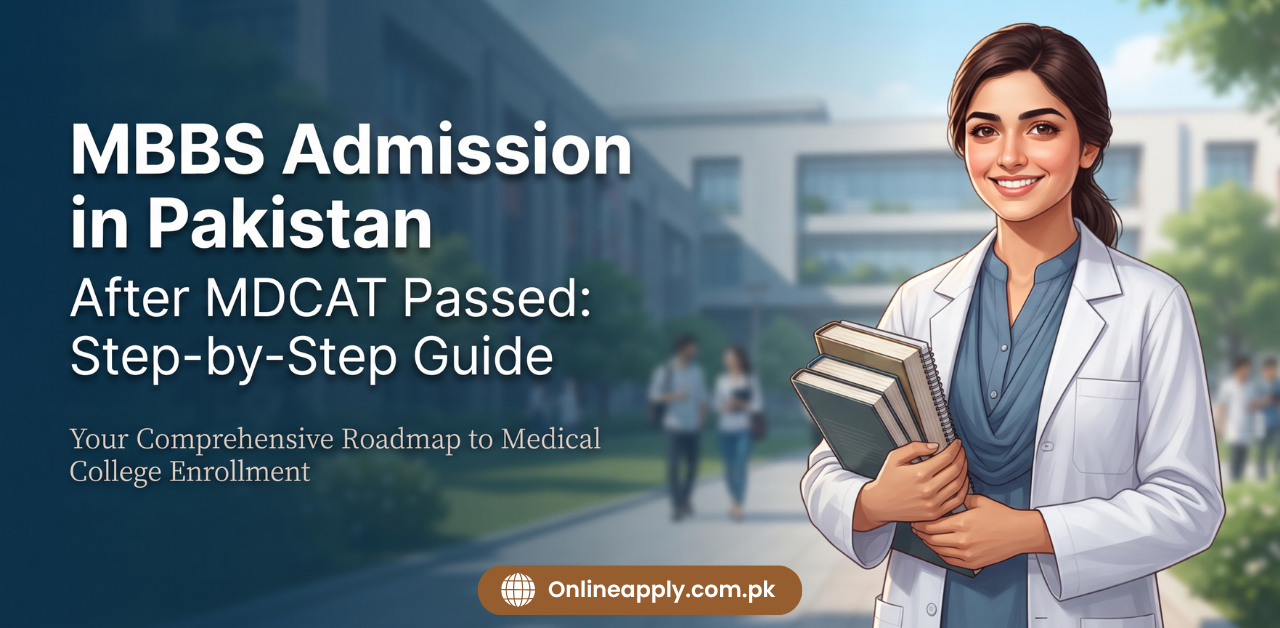
You survived MDCAT. Take a second to breathe, because honestly, that part was the boss fight. But the game isn’t over: now comes the part where paperwork, deadlines and merit math decide where you actually study.
This guide is for students who already have a result in hand. We’ll cover what to prepare, how merit works, how to choose colleges and what to do if things don’t go perfectly. Let’s get you from “I passed” to “I’m admitted.”
Where You Stand After MDCAT 2026
The passing marks are 99 out of 180 (55%) for MBBS and 90 out of 180 (50%) for BDS. Clearing that bar makes you eligible to apply, but it doesn’t guarantee a seat. Your seat depends on your aggregate, which combines your MDCAT score with your FSc and matric marks, and on how many people compete for the college you want.
Results have been coming out through the testing universities: Punjab’s was announced on 24 September 2026, and Balochistan’s followed. MDCAT is national, but admission is handled by provincial admitting universities through their own online portals. So the process below is the same everywhere, while exact dates and portal links depend on your province.
Check out: What to do after MDCAT If you’re Passed (or Failed).
Step 1: Get Your Documents Ready (Do This Today)
Admission windows can be short, and a missing document is the easiest way to lose a seat. Admitting universities publish their own lists in the prospectus, but the core set looks like this:
- Matric (SSC) certificate and marks sheet
- FSc/HSSC Pre-Medical certificate and marks sheet
- IBCC equivalence certificate if you did O/A-Levels or studied abroad. IBCC attestation of documents can also be mandatory at the time of admission, depending on the admitting university
- Domicile certificate (see the seat types section for how domicile affects your options)
- CNIC or B-Form of the candidate
- CNIC of your father, mother or guardian
- MDCAT result card or PMDC result certificate. PMDC’s system has a roll-number-based certificate facility, so watch for the 2026 instructions
- Recent photographs
- Category-specific documents if you’re applying under a quota, such as a disability certificate
Scanning tips that save applications:
- Upload each document as a separate file, not one giant PDF
- Scan both sides of the CNIC as separate files
- Make scans clear and legible, since blurry documents get rejected
- Never submit forged or doctored documents. Fake paperwork can get you permanently debarred
Some provinces also ask for attested photocopies in hard form, especially for quota seats. Read your prospectus line by line.
Step 2: Calculate Your Aggregate
Public and private colleges alike generally use the PMDC formula:
- Matric: 10%
- FSc: 40%
- MDCAT: 50%
Worked example: 1000/1100 in Matric, 1000/1100 in FSc and 150/180 in MDCAT.
- Matric: (1000 ÷ 1100) × 10 = 9.09
- FSc: (1000 ÷ 1100) × 40 = 36.36
- MDCAT: (150 ÷ 180) × 50 = 41.67
- Aggregate ≈ 87.12%
Do this calculation before you fill any form, so your preference list is realistic.
What Aggregate Is Competitive?
This changes every year with paper difficulty and the applicant pool, so treat last year’s numbers as a rough guide only. Reported historical closings for open-merit seats show top public colleges closing above about 92%, with many other public colleges closing somewhere between roughly 88% and 91%. Private colleges usually close lower. Those are third-party figures, so check the official closing merits published by your admitting university for the previous session.
Step 3: Know Your Seat Options
Public-sector colleges are the cheapest and most competitive. Seats are usually tied to your province’s domicile. For example, one major admitting university makes provincial domicile mandatory for public-sector seats.
Private colleges generally accept domicile from any district of Pakistan, which gives you more flexibility if your public-sector merit falls short. Fees are much higher, so check them in the prospectus before applying.
Seat categories you may see include:
- Open merit: competed purely on aggregate
- Reserved or quota seats: based on provincial policy, with extra documents required
- Self-finance seats: paid seats, sometimes available in public-sector colleges
- Overseas Pakistanis and foreign nationals: separate categories with their own rules
NUMS and military-administered colleges run a separate process. NUMS conducts its own MDCAT for admission to its constituent, affiliated and armed-forces-administered medical and dental colleges, and only that NUMS test counts for those seats. If you’re targeting them, follow the NUMS website separately.
Always confirm the college is PMDC-recognized. Admission offers are typically contingent on PMDC’s approval of the college, and admitting universities ask you to acknowledge that in an undertaking.
Step 4: Apply on the Admission Portal
Applications are submitted online, and public and private sector portals are often separate, as are MBBS and BDS. The typical flow looks like this:
- Register with your CNIC/B-Form and create a password
- Select the seat category or categories you’re eligible for
- Enter your SSC and HSSC details (marks, year, subjects)
- Enter your MDCAT roll number and score
- Upload your documents
- Read and accept the undertaking
- Generate the fee challan and pay the non-refundable processing fee, which varies by admitting university and has been in the low thousands of rupees in recent cycles
Examples of admitting universities that run these portals include UHS, DUHS, KMU and BUMHS, and each has its own prospectus and dates.
Don’t wait for the last day. Portals get crowded, payments get delayed, and a single error can mean a missed window.
Step 5: Fill Your Preferences Smartly
Most centralized portals ask you to rank colleges in order of priority. The system then places you at the highest-ranked college your aggregate qualifies for, and later lists shift seats as others leave.
How to rank wisely:
- Put your dream colleges first, even if they feel like a stretch, since the system will only place you there if your merit qualifies
- Follow with realistic mid-range options based on last year’s closing merits
- Add safer choices you’d genuinely be willing to join
- Only list colleges you’d actually attend. Don’t use a seat you don’t want as a placeholder
- Read the rules on upgradation (moving to a higher-preference college in later rounds) and what happens if you accept a seat, because policies differ
Some admitting universities have in past cycles allowed candidates to use the better of two recent MDCAT scores. If you’ve attempted MDCAT before, check whether this year’s policy allows it.
Step 6: Merit Lists, Selection and Joining
Merit lists come out in rounds. The first list fills seats based on preferences, and unclaimed seats move into the next list. A typical sequence is:
- Provisional or first merit list
- Objection or correction window (if your university offers one)
- Subsequent selection lists as seats open up
- Final list
If you’re selected: submit the prescribed fee and complete document verification within the deadline. Missing the window can cost you the admission and any chance of upgradation. Carry originals, since some universities verify them, and keep multiple photocopies.
Then watch for the joining date, orientation and class start date.
Plan B: If Your Merit Falls Short
Not getting your top choice isn’t the end:
- Look at private colleges. Many accept students with a lower aggregate, and most accept domicile from anywhere in Pakistan
- Check self-finance seats at public-sector colleges
- Watch later merit lists. Seats do open up as candidates move or withdraw
- Explore other health programs like BDS, DPT or allied health sciences, if medicine is the goal but MBBS isn’t working this year. See the [DPT guide on our site] if you’re curious
- Retake MDCAT next cycle. Last cycle’s rules had no attempt limit, but check PMDC’s notice for the next one
- Think carefully about studying abroad. PMDC requires at least 50% in MDCAT or an equivalent foreign admission exam for students seeking medical admission overseas, and foreign graduates face a licensing exam on return
Common Mistakes That Cost Students Seats
- Waiting until the deadline to start the application
- Uploading blurry scans or combining documents into one file
- Ignoring domicile requirements for public-sector seats
- Not calculating the aggregate before filling preferences
- Listing colleges you don’t actually want
- Missing the fee deadline after being selected
- Trusting unofficial pages or agents who promise a guaranteed seat or “confirm” your admission for money. Use only official university and PMDC channels
Expected Timeline
PMDC and the admitting universities set the dates, and they can shift. As a rough guide, applications open soon after results, first merit lists follow within a few weeks, and further lists continue until seats fill. One third-party tracker expects the first merit lists around early to mid November 2026, but that’s an estimate, not an official schedule. Check your admitting university’s website daily.
Frequently Asked Questions
1. I passed MDCAT. Am I guaranteed a seat?
No. Passing makes you eligible. Your aggregate and the number of competitors decide your seat.
2. How is MBBS merit calculated?
10% Matric, 40% FSc and 50% MDCAT.
3. Can I apply to colleges in more than one province?
Public-sector seats usually depend on domicile, so cross-province options are limited. Private colleges generally accept domicile from any district. Check each prospectus.
4. Do I need an IBCC certificate?
Yes, if you hold O/A-Levels or another foreign qualification.
5. Is there an application fee?
Yes. Admitting universities charge a non-refundable processing fee that varies by university.
6. Can I change my preferences after submitting?
It depends on the admitting university. Read the prospectus before you finalize.
7. What if I miss the fee deadline after selection?
You can lose the seat and the chance to be upgraded, so pay on time.
8. Do military-administered colleges use the same test?
No. NUMS runs its own MDCAT for those colleges, so follow its separate process.
9. What aggregate do I need for a government college?
It varies each year. Historical open-merit closings have run from the high 80s to the low 90s, with top colleges at the upper end.
10. Where do I find official dates?
On PMDC’s site and your admitting university’s website, not on rumor pages.
Bottom Line
You’ve done the hard part, and now it’s about being organized and strategic. Get your documents ready, calculate your aggregate honestly, rank your colleges smartly and check official portals every day. Do that, and you’ll give yourself the best possible shot at a seat.
Good luck, future doctor. You’ve earned this moment, so go finish the job. 🩺